
close
Choose Your Site
Global
Social Media


Views: 88 Author: Site Editor Publish Time: 2026-05-26 Origin: Site


Selecting the right mold quick coupling is not only a matter of connection size; it affects sealing reliability, cooling efficiency, maintenance speed, and long-term equipment stability. In mold cooling systems, injection molding lines, die casting molds, and temperature-control circuits, the difference between European Standard Quick Couplings and American standard quick couplings can determine whether the system connects smoothly or suffers from leakage, mismatch, and repeated downtime. European Standard Quick Couplings are commonly used in metric-based mold systems and compact cooling layouts, while American standard types are often associated with inch-based equipment, replacement systems, or North American tooling specifications.
● European Standard Quick Couplings are commonly used in metric mold cooling systems.
● American standard quick couplings are usually selected for inch-based tooling systems.
● The two standards are generally not interchangeable.
● Hose size, thread type, pressure, temperature, and fluid medium must be checked before selection.
● European Standard Quick Couplings are suitable for compact mold cooling layouts and frequent maintenance.
● The safest choice is based on existing equipment standard, mold drawing, and connector dimensions.
Mold quick couplings are connector fittings used to join or disconnect cooling water lines, oil lines, and temperature-control circuits without complicated tools. In injection molding and die casting, stable connection performance directly affects mold temperature balance, cycle consistency, and surface quality of finished parts. European Standard Quick Couplings are widely applied where compact installation, repeated operation, and metric-compatible hose or fitting layouts are required.
A mold coupling may look simple from the outside, but its locking groove, plug profile, sealing position, and dimensional tolerance must match the socket correctly. If European Standard Quick Couplings are connected with incompatible American standard parts, the joint may appear engaged but still create hidden leakage or unstable flow. Standard selection therefore has to be treated as a technical decision rather than a visual comparison.
Mold quick couplings are commonly used in plastic injection molds, die casting molds, temperature controllers, cooling manifolds, water distribution blocks, and industrial hose assemblies. European Standard Quick Couplings are especially practical in mold factories and production lines where metric design drawings and compact water circuits are standard practice. American standard types remain suitable when the machine, mold base, or replacement inventory follows inch-based specifications.
European Standard Quick Couplings are usually associated with metric-friendly dimensions, compact bodies, and connection styles suitable for mold cooling water circuits. Their design is often selected for systems where hose barb nipples, threaded plugs, and matching sockets must fit neatly into limited mold space. In applications with frequent mold changes, European Standard Quick Couplings can reduce connection time while maintaining stable sealing when properly specified.
Modern mold designs often leave very little room around cooling ports, ejector systems, and clamping areas. European Standard Quick Couplings are often preferred in such conditions because compact connector geometry can reduce interference between hoses, mold plates, and machine structures. When the mold has multiple cooling circuits in a narrow layout, European Standard Quick Couplings can make hose routing cleaner and easier to manage.
European Standard Quick Couplings are a practical choice when the mold drawing, machine system, hose size, or existing fittings already follow European or metric standards. They are also suitable when maintenance teams need fast disconnection during mold changes, cleaning, or cooling line inspection. If the production site uses several molds built around metric cooling ports, standardizing European Standard Quick Couplings can simplify spare part control.
Selection Factor | European Standard Quick Couplings | American Standard Quick Couplings |
Measurement tendency | Commonly metric-compatible | Commonly inch-based |
Typical mold use | European-style or metric tooling | North American-style tooling |
Layout advantage | Compact cooling line installation | Suitable for existing inch systems |
Interchangeability | Usually not interchangeable with American type | Usually not interchangeable with European type |
Best selection basis | Mold drawing, hose size, sealing design | Existing equipment and replacement standard |
American standard mold quick couplings are often used in equipment and tooling systems designed around inch-based dimensions. Their plug profiles, socket geometry, and thread options may differ from European Standard Quick Couplings even when the nominal size appears similar. This difference is important because the same apparent hose size does not guarantee the same locking depth, sealing contact, or flow path.
American standard quick couplings are generally the better option when the existing mold, machine, or inventory already uses American specification fittings. Replacing only one side with European Standard Quick Couplings in an American standard circuit can create mismatch risk and unstable sealing performance. In maintenance work, the safest replacement method is to confirm the original standard and match both plug and socket within the same system.
American standard quick couplings are not inferior by default, but they are not the best match for every mold cooling layout. In metric mold environments, forcing American standard fittings into the system may require adapters, extra space, or additional inventory control. Where European Standard Quick Couplings are already used across machines and molds, switching standards without a clear reason may increase complexity.

The biggest difference between European Standard Quick Couplings and American standard quick couplings is dimensional compatibility. Locking diameter, plug length, seal contact position, and socket engagement depth may vary even when the outside appearance is close. Because of these hidden differences, European Standard Quick Couplings should be paired with matching European standard sockets or plugs instead of being mixed with American standard components.
Sealing reliability depends on correct compression between the seal and the mating surface inside the coupling. If European Standard Quick Couplings are used with mismatched components, the sealing ring may not sit in the correct position, causing slow leakage, pressure loss, or sudden disconnection under vibration. In mold cooling systems, even minor leakage can affect temperature stability, contaminate the machine area, and interrupt production.
Flow performance is affected by internal bore size, valve structure, passage geometry, and connector alignment. European Standard Quick Couplings selected with the correct hose barb and socket size can maintain consistent cooling water flow through the mold circuit. If the coupling standard is wrong, restriction or partial engagement may reduce cooling efficiency and create uneven mold temperature.
Technical Item | What to Check | Risk If Ignored |
Plug and socket profile | Same standard and matching series | Loose connection or no connection |
Hose barb size | Hose inner diameter and clamp fit | Hose slippage or leakage |
Thread type | Metric, BSP, NPT, or other specification | Thread damage or sealing failure |
Working pressure | System pressure and safety margin | Leakage or coupling failure |
Temperature range | Cooling water, oil, or heated medium | Seal hardening or deformation |
Material compatibility | Brass, steel, stainless steel, or other material | Corrosion or reduced service life |
Before choosing European Standard Quick Couplings or American standard quick couplings, the existing mold and machine standard should be identified. The most reliable references are mold drawings, original fitting codes, plug samples, socket measurements, and equipment documentation. If the system is already built around European Standard Quick Couplings, keeping the same standard can reduce replacement errors and compatibility problems.
Hose barb nipple size must match the hose inner diameter, clamp method, and expected fluid flow. European Standard Quick Couplings for hose connections should be selected according to hose size, coupling series, and whether the system requires a plug, socket, or complete set. A coupling that fits the hose but does not match the mating connector is still unsuitable for the system.
Mold cooling systems may use normal cooling water, treated water, oil, or temperature-control fluids, and each medium places different demands on the coupling and seal. European Standard Quick Couplings must be selected with pressure rating, temperature resistance, and seal compatibility in mind. Ignoring these working conditions can shorten coupling life even when the dimensional standard is correct.
European Standard Quick Couplings and American standard quick couplings should not be mixed simply because the parts appear similar. A mismatched connector may lock partially, seal poorly, or fail after repeated vibration and thermal cycling. For safe operation, both male and female sides should follow the same standard, same series, and compatible size.
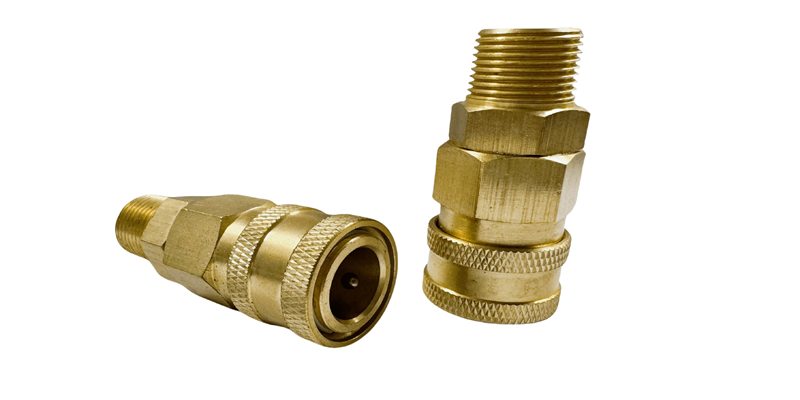
Many mold quick couplings have similar shapes, especially when viewed without measuring tools. European Standard Quick Couplings may resemble American standard fittings in body shape, but internal locking and sealing dimensions can be different. Selection by appearance alone often leads to poor fit, leakage, or repeated trial-and-error replacement.
A quick coupling has more than one connection point, so the mating side and the hose or thread side must both be correct. European Standard Quick Couplings with hose barb nipples must match the hose inner diameter and clamping condition, while threaded versions must match the exact thread specification. If only the coupling standard is checked and the hose or thread detail is ignored, installation failure can still occur.
Some maintenance teams replace only the plug or only the socket to reduce immediate cost, but this can create compatibility risk when the old part belongs to a different standard or series. European Standard Quick Couplings perform best when the mating plug and socket are designed to work together. Replacing both sides as a matched set is often more reliable when the original standard is uncertain.
A complete specification should include coupling standard, nominal size, hose barb size, plug or socket type, and overall connection form. For European Standard Quick Couplings, dimensional confirmation is especially important when the mold has multiple cooling circuits with limited spacing. Providing measurements or samples can prevent confusion between visually similar European and American standard fittings.
Working pressure, operating temperature, fluid type, and connection frequency should be confirmed before final selection. European Standard Quick Couplings used in high-frequency mold changes need stable locking performance and durable sealing materials. A fitting that works in low-pressure cooling water may not be suitable for heated oil, aggressive fluids, or higher-pressure circuits.
Standardizing the coupling type across machines and molds can reduce spare part confusion and maintenance delays. If a workshop already uses European Standard Quick Couplings across most mold cooling lines, keeping the same standard is usually more efficient than adding another connector family. Consistent specification also makes training, inspection, and replacement procedures easier to control.
European Standard Quick Couplings and American standard mold quick couplings serve similar functions, but they are designed around different dimensional systems, connection profiles, and application habits. The right choice depends on the mold drawing, existing machine standard, hose size, thread type, pressure, temperature, and fluid medium rather than on appearance alone. For metric mold cooling systems, compact hose layouts, and European-style tooling, European Standard Quick Couplings are often the more suitable option, while American standard types should remain in systems already built around that specification. If accurate selection is required for mold cooling hose connections or industrial fluid circuits, Dongguan Tianying mold fitting Co., Ltd. can provide suitable quick coupling options based on samples, drawings, or working conditions.
European Standard Quick Couplings are generally not interchangeable with American standard quick couplings because the plug profile, locking groove, and seal position may differ. Even if two fittings look similar, the internal dimensions can prevent correct engagement or sealing. Mixing standards can cause leakage, unstable connection, and faster wear during repeated operation.
European Standard Quick Couplings can be identified by checking the original mold drawing, fitting dimensions, connection profile, and matching socket or plug series. Measuring only the outside diameter is not enough because several standards can share similar external shapes. A sample comparison or technical drawing confirmation is usually the safest method.
European Standard Quick Couplings should be selected when the mold system follows metric dimensions, European-style tooling, or compact cooling line arrangements. They are also suitable when existing sockets, plugs, or hose fittings already belong to the European standard system. Consistency across the entire cooling circuit reduces installation errors and maintenance complexity.


