
close
Choose Your Site
Global
Social Media


Views: 0 Author: Site Editor Publish Time: 2026-07-28 Origin: Site


Unplanned downtime in injection molding often originates in the cooling system. Fluid leaks, flow restrictions, or sudden pressure drops quickly ruin production efficiency. Compromised thermal management extends cycle times and degrades final part quality. The DME profile currently stands as the definitive industry benchmark for mold cooling interoperability. You must fully understand how these specific couplings mechanically actuate under pressure. You also need to recognize their exact material limitations. This knowledge remains absolutely critical for standardizing your facility tooling. Standardization actively eliminates dangerous cross-connections and reduces your daily maintenance overhead. Below, we break down the internal locking mechanism of these essential components. We provide a rigorous material evaluation comparing common industrial options. We also examine essential spatial routing configurations. You can use this technical framework to make highly informed, reliable procurement decisions.
DME standard brass quick couplings utilize a retracted locking-sleeve mechanism secured by internal ball bearings to create a leak-free, high-flow connection.
Brass provides the optimal balance of corrosion resistance, thermal conductivity, and cost for standard water and glycol mold cooling applications compared to steel or plastics.
Selecting the right geometry—such as opting for a 90-degree elbow connector in tight mold clearances—prevents hose kinking and lateral stress on the coupling seal.
Facility-wide standardization requires verifying true DME profile compatibility to avoid hazardous cross-connections and pressure blowouts.
A standard coupling relies on a highly proven spring-loaded outer sleeve. Internal retaining ball bearings secure the entire connection. You push the outer sleeve back manually. This simple action allows the internal metal balls to retract outward. The socket then easily accepts the machined plug profile. When you release the sleeve, the internal spring forces the balls downward. They lock securely into a specific groove machined onto the plug. This creates a rigid mechanical bond. It resists high-vibration environments effectively. You get a secure connection without needing threaded wrenches.
The internal O-ring dictates the absolute reliability of your watertight seal. Plugs compress directly against this elastomeric component. Most industrial facilities utilize Viton (FKM) or EPDM seals depending on the coolant chemistry. As fluid pressure inside the line increases, the fluid pushes the plug harder against the O-ring. This active compression prevents leaks during active operation. The system effectively uses its own internal pressure to strengthen the seal. Proper seating is mandatory. A misaligned plug will pinch the O-ring and cause an immediate failure.
You must choose between thermal flow efficiency and operational convenience. These two dynamics dictate your cycle times and maintenance speed.
Unvalved (Straight-Through): These designs feature a completely open internal diameter. They maximize turbulent fluid flow. High turbulence ensures optimal heat transfer inside the mold block. However, you must drain the entire system before disconnection to prevent massive fluid spills.
Valved (Shut-Off): These models feature an internal spring-loaded poppet valve. The valve stops coolant flow instantly the moment you disconnect the fitting. They are ideal for rapid mold changes. Yet, the internal valve mechanism introduces a minor pressure drop. This slightly reduces your total volumetric flow rate.
The DME standard relies on extremely precise dimensional geometry. A genuine DME standard brass quick coupling guarantees positive engagement across all compatible tooling. Engineers designed this profile to reject unmatched plugs. This safety feature prevents accidental decoupling on the factory floor. True interoperability means you can move a mold from one machine to another seamlessly. The connectors will engage perfectly every time.
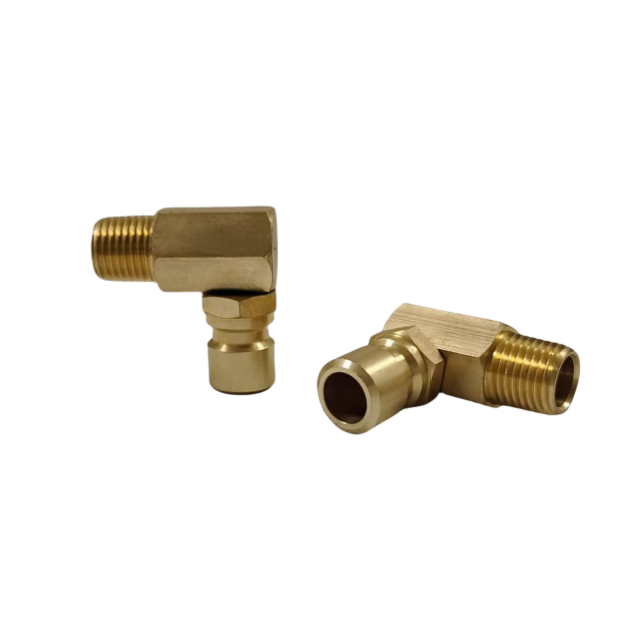
Brass delivers superior natural corrosion resistance. Injection molding heavily relies on standard facility water and water-glycol mixtures. These specific fluids degrade inferior metals rapidly through continuous oxidation. Brass naturally resists this degradation. Furthermore, brass possesses excellent thermal conductivity properties. It also maintains a lower Rockwell hardness compared to hardened mold steel. This material softness actively protects your mold-side plugs. Repeated daily connections will not gall or damage the expensive mold interface. The brass sleeve wears out before the tool steel plug does.
Some facility operators prefer steel components. Steel undoubtedly offers higher burst pressure ratings. It survives severe physical drop impacts much better than softer metals. However, steel fails frequently in standard water cooling applications. It rusts internally over time. This rust eventually flakes off into the circulating fluid. The resulting particulate contamination clogs delicate internal cooling channels inside the mold. Once those channels clog, your cooling efficiency drops dramatically. Steel works well for hydraulic oil, but it causes severe issues in standard water loops.
Plastic fittings provide a noticeable weight reduction. They completely eliminate rust concerns. Unfortunately, synthetic polymers degrade rapidly under continuous thermal cycling. They suffer from structural embrittlement. Industrial molding environments routinely induce severe environmental stress cracking in plastics. Exposure to ambient UV light and chemical vapors accelerates this breakdown. Therefore, a standard brass quick coupling remains your most reliable baseline. It balances thermal stability, impact resistance, and long-term durability flawlessly.
Material Type | Corrosion Resistance (Water) | Impact Strength | Thermal Stability |
|---|---|---|---|
Brass | Excellent | Moderate | Excellent (up to 400°F depending on seal) |
Steel | Poor (Prone to internal rust) | High | Excellent |
Plastic | Absolute | Low (Prone to cracking) | Poor (Embrittles over time) |
Straight connections remain the industry default for open manifolds. However, heavy industrial rubber hoses exert immense lateral pull. This side-load stress transfers directly to the fitting interface. It physically deforms the internal elastomeric O-rings. Minor deformations quickly cause micro-leaks. You lose valuable treated coolant. You also compromise floor safety by creating slipping hazards. Properly managing this stress extends the lifespan of every connection on your press.
Tight mold clearances demand better spatial routing strategies. You should strongly consider implementing a 90 degree elbow connector in restrictive spaces. This hardware routes the heavy hose parallel to the mold platen. Parallel routing completely eliminates sharp hose kinking. It drastically reduces the physical footprint of the tooling setup. Most importantly, it mitigates lateral leverage on the fitting seal. The hose weight hangs down naturally instead of pulling sideways. This simple geometry change stops the majority of nuisance drips.
Hose tension fluctuates wildly during press operation. A high-quality quick release elbow incorporates crucial swivel capability. Swiveling allows thick hoses to naturally find their resting angle as the mold opens and closes. They settle smoothly without torquing the primary locking mechanism. If the fitting cannot swivel, the rigid hose eventually twists the plug out of alignment. Swivel joints ensure the fluid flow remains completely unrestricted while absorbing mechanical movement.
You must confirm your facility operational limits before purchasing hardware. Injection molding generally requires low-to-medium pressure cooling systems. A standard 200 PSI maximum rating comfortably covers most ambient applications. Ensure your selected mold coolant coupling meets these specific pressure requirements safely. Also, rigorously verify the temperature rating. The internal O-ring material limits maximum heat tolerance, not the external brass body. Standard EPDM handles general cooling, while FKM manages high-heat synthetic oils.
Overall cooling efficiency relies heavily on internal diameter (ID) optimization. You must assess the internal flow path constraints carefully. A poorly machined regional clone might look identical to a true DME quick coupling externally. However, inferior clones often feature restrictive internal flow paths. They leave rough machining burrs inside the valve body. These restrictions induce severe pressure drops. A reduced flow rate severely compromises your mold cooling times and extends your total cycle duration.
Counterfeit profiles introduce extreme operational risks. Many suppliers market fittings as "compatible" without strictly adhering to the dimensional standard. You face chronic nuisance leaks daily. Worse, slightly off-spec clones risk catastrophic decoupling under operational pressure. When a hot coolant line blows off mid-cycle, you risk severe operator injury and damaged equipment. Always demand strict dimensional verification from your supplier.
Measure your average cooling line pressure at the manifold.
Identify the specific coolant chemistry (e.g., city water, glycol mix, synthetic oil).
Determine the required volumetric flow rate to maintain thermal targets.
Specify the correct O-ring material based on peak operating temperatures.
Verify exact plug and socket dimensions against standard engineering schematics.
Physical abuse frequently destroys brass fittings. Dropping a heavy manifold block deforms the brass locking sleeves. A dented sleeve cannot retract smoothly to release the internal balls. Chemical degradation represents another major failure mode. Using incompatible synthetic coolants destroys standard elastomeric O-rings rapidly. Furthermore, maintenance teams often flush cooling lines with harsh descaling acids. These aggressive acids dissolve both the rubber seals and the internal brass components over time. You must flush the system with neutralizing water immediately after any descaling procedure.
Mixed-profile environments create massive operational hazards. You cannot mix DME, Staubli, and Hasco profiles on the same production floor safely. Inexperienced operators will eventually force incompatible connections together. This causes instant pressure blowouts or hidden micro-leaks. You must execute a hard cutover strategy. Replace all mismatched fittings simultaneously during a scheduled plant shutdown. Standardizing on a single profile eliminates guesswork. It drastically reduces your spare parts inventory overhead.
Do not run operational fittings until they fail completely. Establish strict visual inspection criteria for your maintenance team. Check the internal ball bearings for flat spots or severe abrasive wear. Test the outer sleeve spring tension manually. A sluggish sleeve indicates severe internal fouling or spring fatigue. Retire aging couplings proactively before they cause a mid-cycle leak.
Inspect the locking sleeve for dents, gouges, or sluggish retraction weekly.
Lubricate internal ball bearings periodically with an approved, non-reactive silicone spray.
Replace O-rings annually or immediately after any severe over-temperature event.
Audit hose routing visually to ensure heavy lines are not side-loading straight connectors.
The fundamental mechanics of these brass fittings remain beautifully simple and highly effective. When you specify and install them correctly, they provide years of leak-free service. True interoperability relies entirely on strict dimensional adherence. You should base all procurement decisions on exact profile compatibility. Define your peak operating temperatures clearly to dictate the correct seal material. Always evaluate your spatial routing requirements thoroughly. Utilize elbows where straight connectors introduce unnecessary lateral stress. Finally, audit your current mold setups immediately. Look closely for signs of severe hose stress or hidden leaks. Identify any incompatible profiles hidden across your facility. Standardize your purchasing requirements moving forward to protect your production efficiency.
A: The maximum temperature limit depends almost entirely on the internal seal material, not the brass body itself. Standard EPDM O-rings typically handle up to 300°F (150°C). Viton (FKM) seals can safely withstand temperatures up to 400°F (200°C). Always match the seal chemistry to your specific coolant and operational heat parameters.
A: No. You must never mix different connection profiles. Forcing a DME plug into a Staubli or Hasco socket creates severe safety risks. It immediately damages the internal O-ring. This practically guarantees high-pressure fluid leaks or explosive decoupling during press operation.
A: Choose a valved coupling when clean, rapid mold changeovers are your top priority. The internal valve prevents messy fluid spills on the factory floor. Choose an unvalved coupling when you need maximum volumetric flow. Unvalved models provide turbulent flow, which optimizes heat transfer and cooling efficiency.
A: O-ring lifespan depends heavily on your thermal cycling frequency and coolant chemistry. For systems running constantly at high temperatures, replace the O-rings every six months. For standard ambient water cooling, an annual replacement schedule prevents rubber hardening, micro-leaks, and sudden seal failures.


