
close
Choose Your Site
Global
Social Media


Views: 0 Author: Site Editor Publish Time: 2026-08-31 Origin: Site


Industrial fluid networks rely heavily on secure and precise connections to keep operations running smoothly. Specifying the wrong material for a hose tail quick coupling inevitably leads to premature wear, fluid contamination, and potentially catastrophic system failures. Buyers often default to legacy materials without evaluating modern engineered alternatives. They also frequently skip checking specific media compatibility. This oversight introduces significant safety risks and compliance violations. Furthermore, relying on outdated choices drastically increases your long-term maintenance and replacement expenses. We will provide procurement and engineering teams with a clear, data-driven framework. You will learn how to evaluate coupling materials based on chemical compatibility, pressure thresholds, and environmental demands. Ultimately, this guide helps you align the exact metal or polymer to your specific operational reality to ensure lasting reliability.
You cannot select the right coupling material without first defining the exact parameters of your system. Choosing materials based purely on habit or upfront costs introduces massive business risks. When system components fail, the resulting downtime impacts your entire production schedule.
Material misalignment triggers a domino effect of system failures. If you mix incompatible metals within a fluid system, you invite galvanic corrosion. This electrochemical process rapidly degrades the weaker metal, causing leaks. Similarly, thermal degradation occurs when you expose standard plastics to excessive heat. They soften, lose structural integrity, and eventually warp. Pressure blowouts present an even greater safety hazard. When a material lacks the tensile strength to handle pressure spikes, the coupling can violently detach from the hose.
Industry professionals rely on a proven evaluation framework before comparing specific alloys or polymers. We call this the STAMP method. You must establish these five baseline criteria:
Many procurement teams assume cheaper materials save money. Standard plastics or low-grade brass might look attractive on a preliminary budget sheet. However, you must evaluate the long-term financial impact. In heavy-duty industrial cycles, a cheaper coupling fails faster. The true expense includes production downtime, spilled fluids, cleanup labor, and frequent replacement parts. Investing in premium materials upfront dramatically reduces these long-term maintenance expenses.
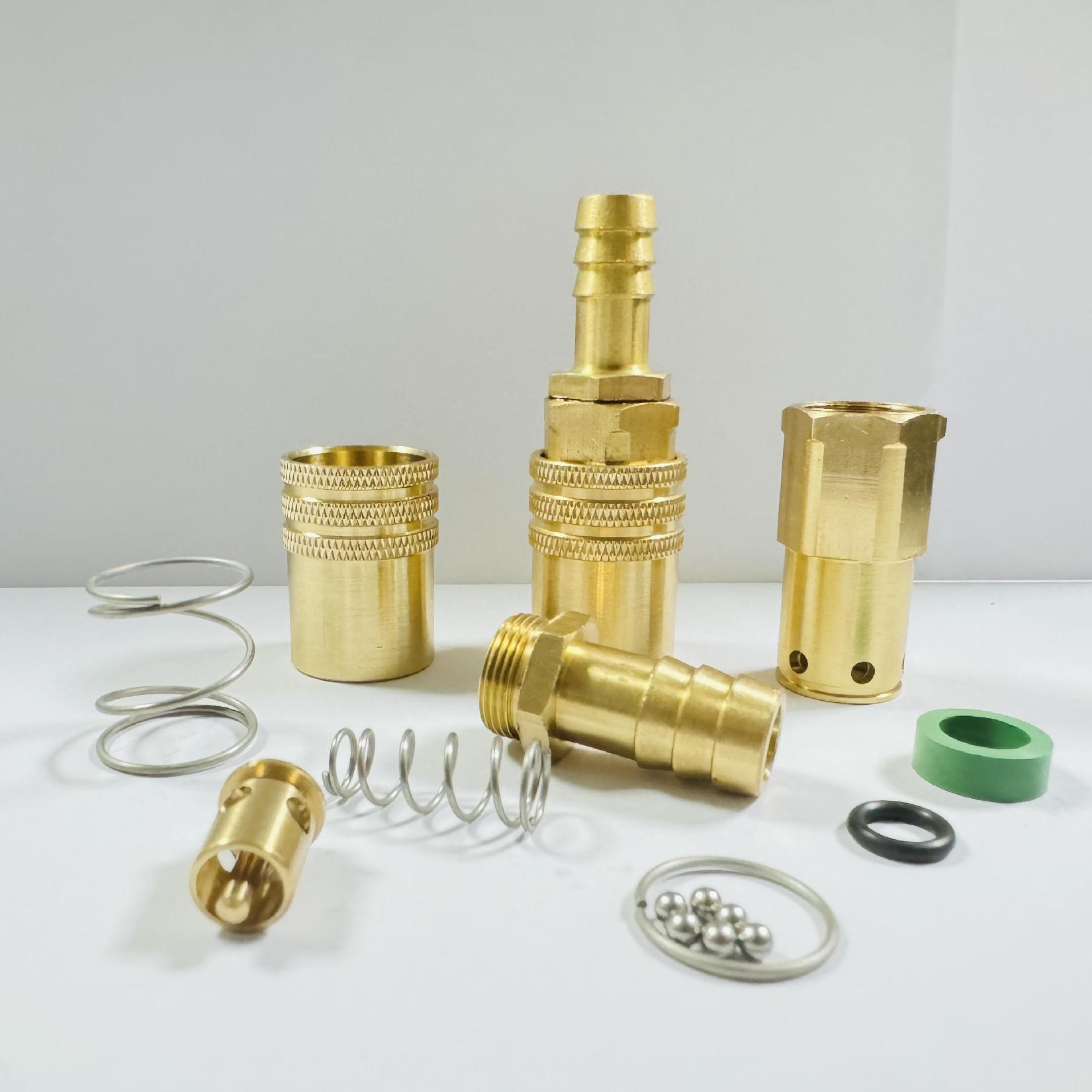
Once you define your baseline parameters, you can evaluate the primary materials available. Each material offers distinct advantages and specific limitations.
Stainless steel represents the premium tier for industrial fluid connections. It delivers exceptionally high tensile strength and extreme temperature tolerance. However, you must distinguish between grade 304 and grade 316.
Grade 304 handles most general-purpose industrial needs effectively. It resists typical rust and oxidation. Grade 316 includes added molybdenum. This critical addition provides superior resistance to chlorides and harsh industrial solvents.
These traditional metals remain incredibly popular across standard industrial sectors. Brass offers excellent machinability, which keeps production costs manageable. It naturally resists water-induced corrosion. Carbon steel, on the other hand, provides maximum physical durability and handles severe high-pressure impacts.
Modern engineered polymers offer compelling alternatives to heavy metals. They are lightweight, cost-effective, and completely immune to galvanic corrosion. Acetal (POM) provides excellent mechanical strength for air and water. Polypropylene (PP) handles basic chemicals well. PVDF stands out for handling highly aggressive acids and bases.
| Material Type | Primary Strength | Notable Weakness | Ideal Application |
|---|---|---|---|
| 316 Stainless Steel | Superior chloride and heat resistance | High initial procurement cost | Pharmaceuticals, Marine |
| Brass | Cost-effective with good water resistance | Vulnerable to dezincification | General pneumatics, Water lines |
| Carbon Steel | Maximum burst pressure tolerance | Requires plating to prevent rust | Heavy hydraulic machinery |
| PVDF (Polymer) | Exceptional acid and chemical immunity | Low mechanical shock resistance | Aggressive chemical dosing |
Theoretical material properties only matter when applied to real-world environments. Let us look at how these materials perform in specific demanding scenarios.
Temperature control systems endure punishing operational conditions. When specifying a cooling hoses hose tail quick coupling, your material must withstand rapid thermal cycling. Fluid temperatures might swing from freezing to near-boiling repeatedly. This cycling causes lesser materials to expand, contract, and eventually suffer structural fatigue. Brass serves well in standard cooling lines. However, for specialized coolants like dielectric fluids, you might need high-temp engineered polymers or stainless steel to prevent dangerous coolant contamination.
Common Mistake: Using standard PVC or low-grade plastics in hot-water cooling lines. The plastic softens quickly, causing the hose clamp to lose tension and blow off the barb.
Handling aggressive media requires absolute precision. If you transfer strong acids, alkalis, or reactive solvents, you must default to PVDF or 316 Stainless Steel. You must also avoid mixing reactive metals. If your system piping is stainless steel, installing an aluminum coupling invites galvanic corrosion immediately. PVDF remains highly favored here because it completely removes the risk of metal reactivity while surviving harsh chemical washdowns.
Hydraulic systems power heavy machinery through intense fluid compression. In this sector, carbon steel absolutely dominates. Its burst-pressure ratings far exceed brass or plastics. Hydraulic lines also experience violent mechanical shocks and constant vibration. Carbon steel absorbs these physical impacts without cracking. You must ensure the manufacturer applied a high-quality zinc-nickel plating to the carbon steel to defend against environmental moisture.
Selecting the raw material represents only the first step. You must also verify the physical design and industry certifications to guarantee a safe connection.
A coupling only works if it grips the hose perfectly. When you review hose tail quick coupling specifications, prioritize dimensional accuracy. The hose inner diameter (ID) must match the barb profile precisely. The barbs themselves must feature sharp, well-defined angles. This specific geometry bites into the soft inner wall of the hose. When you apply a clamp over this connection, the precise barb design ensures a leak-free mechanical grip that resists pull-off forces.
The external coupling body material is only half the equation. Inside every quick coupling sits an O-ring or gasket. If you specify a chemically resistant 316 stainless steel body but use a standard rubber O-ring, aggressive chemicals will melt the seal instantly. You must evaluate and specify compatible seal materials based on the media:
Authoritative procurement demands strict adherence to industry certifications. You cannot deploy uncertified components in regulated sectors. Ensure your chosen material meets the exact standard required for your operational environment. Look for FDA compliance if you handle food and beverage processing. Demand ISO standards for critical industrial pneumatics. Require RoHS compliance for electronics cooling applications to ensure no hazardous substances contaminate the area.
Even the best material specifications fall short if the manufacturer cuts corners during production. You must rigorously evaluate your manufacturing partners.
A credible hose tail quick coupling supplier operates with complete transparency. They should eagerly provide Material Test Reports (MTRs) for their metal products. These documents prove the exact metallurgical composition of the batch. If a supplier refuses to provide MTRs, you risk receiving counterfeit alloys. Paying for 316 stainless steel but receiving lower-grade 304 introduces severe chemical vulnerabilities into your system.
Standard off-the-shelf parts frequently fail to meet specialized system requirements. You must evaluate a supplier's engineering capacity. Ask them how they handle non-standard requests. Sometimes you need a custom hose tail quick coupling featuring unique barb counts, non-standard threading, or proprietary alloy mixtures. A premium supplier maintains an in-house engineering team capable of prototyping and machining exact specifications rather than just reselling catalog items.
Do not accept visual inspections as proof of quality. Look for documented quality assurance protocols. The manufacturer should perform rigorous pressure testing and advanced leak detection on their assembly lines. Verify they maintain ISO 9001 certified manufacturing processes. This certification guarantees they follow strict, repeatable procedures that minimize batch-to-batch variations.
Best Practice: Always request sample batches. Install these samples into a non-critical test loop within your facility. Monitor their performance under your actual operational pressure and media conditions before committing to a massive volume order.
Selecting the ideal material requires a systematic approach rather than guesswork. First, clearly define your media and map out the entire operational environment using the STAMP method. Next, carefully review the dimensional specifications to guarantee a secure mechanical grip. Finally, always demand total material traceability from your chosen manufacturing partner. Taking these steps eliminates unexpected failures and optimizes your long-term maintenance budgets. For your next step, contact your supplier and request detailed chemical compatibility charts. Ask for sample batches to conduct real-world field testing before you finalize any volume orders.
A: Focus primarily on your fluid environment. If your system faces chloride exposure, salt water, or highly corrosive industrial solvents, you must choose 316 stainless steel. Its molybdenum content prevents pitting. For standard indoor environments, water lines, or basic washdowns, 304 stainless provides excellent durability at a lower cost.
A: Generally, you should avoid it. Combining metal and plastic often leads to severe cross-threading risks, as the harder metal threads can easily strip the softer plastic. Furthermore, metal and plastic possess vastly different thermal expansion rates. System temperature fluctuations can quickly cause leaks at the connection points.
A: Leaks usually stem from mechanical mismatches. A mismatched barb-to-hose internal diameter prevents a tight seal. Applying improper clamp tension either under-secures the hose or crushes it. Finally, even if the body material survives, internal O-ring degradation will rapidly compromise the entire connection.
A: Industry timeframes vary based on complexity. Typically, initial prototyping and engineering drawings take one to two weeks. Custom tooling adds another two to four weeks. Final production and quality assurance testing usually require an additional three to five weeks. Expect an eight to ten-week total turnaround.


