
close
Choose Your Site
Global
Social Media


Views: 0 Author: Site Editor Publish Time: 2026-08-23 Origin: Site


In injection molding, profitability heavily depends on machine uptime and short cycle times. Every second counts during high-volume production runs. Yet, mold cooling and fluid management often create severe bottlenecks during changeovers. Teams struggle to connect and disconnect traditional fluid lines quickly. Operators lose valuable time handling cumbersome fittings.
Upgrading to a high-quality brass quick coupling system provides a verifiable method to fix this bottleneck. It reduces setup times instantly. It also stabilizes vital thermal control across your molds. Standardizing your connections eliminates unnecessary wrenching and limits fluid loss.
This article gives engineering and procurement teams a clear, objective framework. We will help you evaluate, specify, and source these essential components. You will learn how to optimize changeovers, compare materials, and avoid common installation mistakes in injection molding applications.
Traditional threaded fittings drain your daily productivity. Technicians spend precious minutes wrestling stubborn threads. Wrench time adds up fast across dozens of cooling lines. Cross-threading risks constantly threaten to ruin expensive manifolds. Fluid spills create immediate slip hazards on the factory floor. They also force frustrating cleanup delays before machines can restart.
An injection molding brass quick coupling changes this operational dynamic entirely. Operators get instant, tool-free connections. They simply push the plug into the socket to connect. They pull back the knurled sleeve to disconnect. This single ergonomic action eliminates heavy wrenching entirely. It aligns perfectly with modern SMED principles.
How do you measure this specific success? You must calculate the exact dollar value of minutes saved. Follow these simple steps to determine your return on investment:
These fittings certainly save considerable time on paper. However, you maximize actual ROI only by standardizing them globally. You must standardize connections across your entire tooling library. Mixed systems create shop floor confusion. Standardized systems guarantee speed, predictable maintenance, and seamless mold swaps.
Engineers consistently choose brass for several distinct mechanical properties. It offers excellent machinability. This ensures manufacturers can hit very tight tolerances for leak-free mating. It possesses inherent rust resistance. It also delivers good ambient thermal conductivity. These specific traits perfectly match standard mold cooling requirements.
Plastic couplings might tempt budget-conscious buyers initially. However, brass easily outperforms them over time. Brass delivers far superior pressure ratings. It handles inevitable factory impacts without cracking. You get significantly better longevity in harsh industrial environments. Plastic components often turn brittle under continuous heat. Brass remains structurally resilient year after year.
You might wonder about stainless steel. Stainless steel definitely excels in extreme environments. You need it for harsh corrosive chemicals. You also need it for extreme high-pressure pneumatic systems. But brass wins clearly for standard operations. It remains the most cost-effective choice. It serves as a highly reliable standard for water-based mold coolant systems. Specifying stainless steel often over-engineers simple cooling loops needlessly.
Expect excellent lifecycle performance from brass components. High-cycle injection molding demands extreme durability. Brass survives continuous temperature fluctuations extremely well. It handles frequent coupling cycles reliably. You just need proper handling procedures. Regular inspection easily prevents unexpected operational failures.
| Material Type | Impact Resistance | Corrosion Resistance (Water) | Cost Efficiency | Best Application Fit |
|---|---|---|---|---|
| Standard Brass | High | Excellent | High | Standard water/glycol cooling lines |
| Engineered Plastic | Low | Excellent | Very High | Low-pressure, low-impact environments |
| Stainless Steel | Very High | Superior | Low | Harsh chemicals, cleanrooms, high pressure |
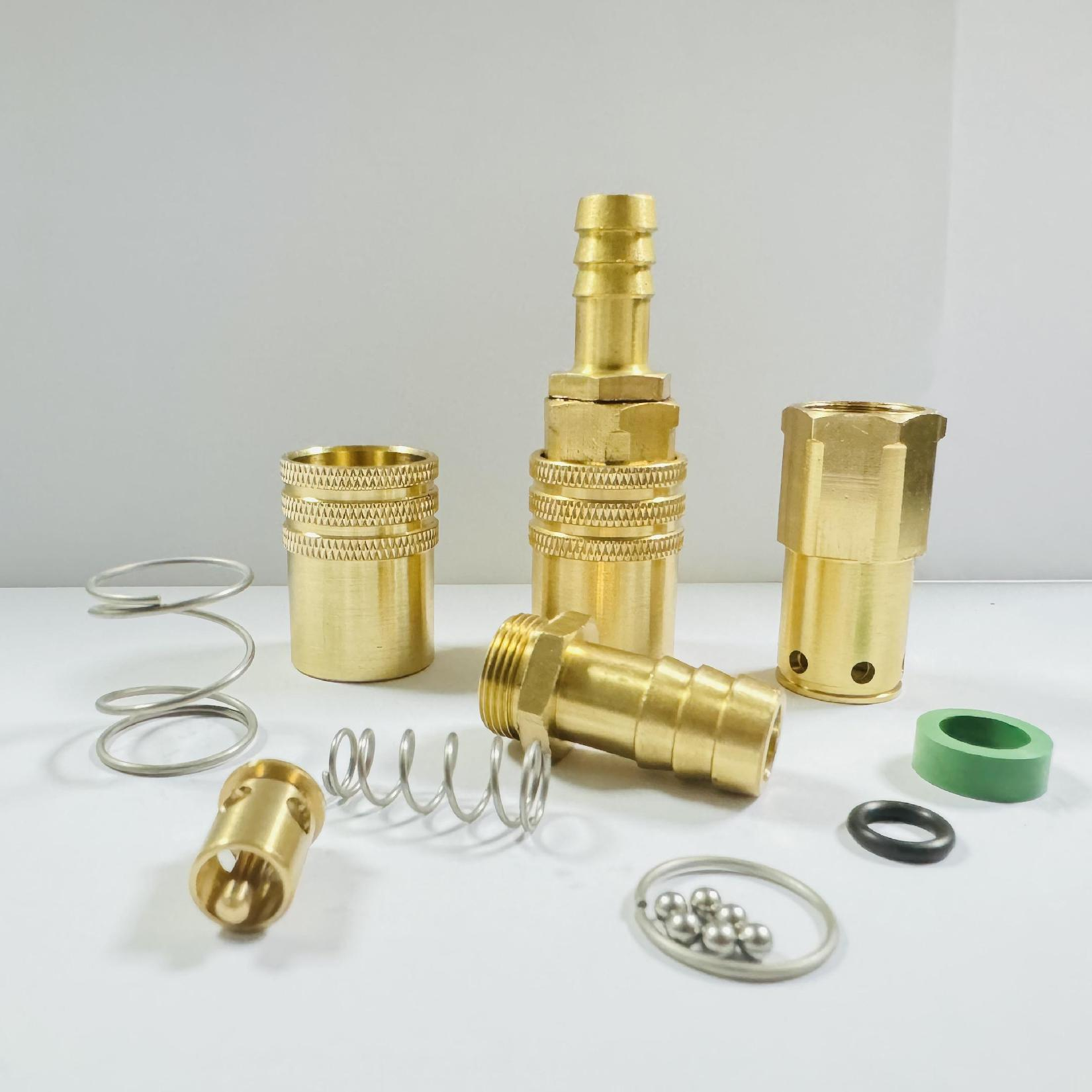
Coolant flow directly dictates your cooling efficiency. Improper inner diameter sizing heavily restricts this vital flow. Restricted flow inevitably causes localized hot spots inside the mold cavity. Hot spots extend your cycle times and warp finished parts. Always size the coupling inner diameter to match your hose inner diameter precisely.
You must actively choose between internal shut-off valves and straight-through designs. Valved designs feature an internal poppet. This poppet prevents coolant spills during routine disconnection. Straight-through designs lack this valve. They maximize fluid flow rate entirely. However, straight-through systems require complete line draining before you disconnect them safely.
| Design Profile | Flow Restriction (Pressure Drop) | Spill Prevention | Ideal Usage Scenario |
|---|---|---|---|
| Valved (Single/Double Shut-Off) | Moderate | Yes | Frequent mold changes where clean floors are critical. |
| Straight-Through (Non-Valved) | None (Maximum Flow) | No | High-volume cooling where maximum heat transfer is needed. |
The internal seal material matters immensely. You must match the seal chemistry to the coolant media. You also must consider peak operating temperatures. FKM handles high heat exceptionally well. EPDM handles hot water and steam perfectly. Nitrile works great for standard factory water and hydraulic oil. Using the wrong seal material causes rapid degradation.
Verifying exact brass quick coupling specifications prevents operational disaster. Check your machine manifolds and mold bases carefully. Common global thread standards include tapered NPT, tapered BSPT, parallel BSPP, and Metric threads. Mismatched threads guarantee messy leaks. Forcing incompatible threads together also destroys expensive custom manifolds.
Facility managers often fall into a common operational trap. They mix incompatible plugs and sockets from different brands. Various manufacturers utilize slightly different internal locking profiles. Mixing them causes invisible micro-leaks. It also accelerates premature internal O-ring failure. Always stick to one unified profile across the entire plant.
Proper installation instantly prevents long-term operational headaches. Mechanics must follow strict assembly rules.
You need a highly realistic maintenance protocol. Focus primarily on mechanical wear and tear. Check the locking sleeves regularly for smooth action. Inspect internal seals visually for minor weeping. Replace sticky or jammed sleeves immediately. This simple preventive protocol stops catastrophic coolant blowouts during active production runs.
Standard catalog couplings work exceptionally well for most shops. They fit standardized cooling manifolds perfectly. They match uniform hose sizes easily across the floor. Off-the-shelf items generally ship quickly. They also cost significantly less to replace during routine maintenance cycles.
Sometimes standard parts fail your specific engineering needs. Tight clearance molds demand highly unique geometric solutions. Multi-coupling plates require exact spacing to function correctly. Specific angle requirements often arise during complex mold builds. You might need a tight 45° or 90° fitting. These demanding scenarios require a custom brass quick coupling. Tailored engineering solutions optimize awkward spaces brilliantly.
Choose your supply partner carefully. Shortlist a reliable brass quick coupling supplier using strict vetting criteria. Demand current ISO certifications first. Look for absolute transparency regarding batch testing. Verify their local inventory availability for critical spares. Ask detailed questions about their engineering support for custom tooling projects. A truly good supplier acts as a long-term technical partner.
Upgrading to engineered brass quick connects delivers immense strategic value. You secure significantly faster mold changeovers. You guarantee reliable, leak-free thermal management. You also achieve much lower long-term maintenance costs. The initial transition requires careful planning, but the operational rewards justify the effort completely.
Take clear action today. Audit your current mold changeover times accurately. Review all existing coolant line specifications across your active machinery. Determine the exact profile and thread requirements for a limited pilot upgrade. Start small on one troublesome machine, prove the concept, and then scale the standard facility-wide.
A: Temperature limits are usually dictated by the internal O-ring material rather than the brass itself. Brass handles high heat well, but seals vary. Nitrile typically maxes out at 200°F. EPDM handles up to 300°F for water/steam. FKM (Viton) can reach up to 400°F. Always check your seal specification.
A: Yes, valved designs introduce a slight pressure drop compared to straight-through couplings. The internal shut-off mechanism restricts the fluid path partially. We strongly advise consulting flow charts and Cv values to ensure your specific cooling cycle is not compromised by this minor restriction.
A: Couplings do not have a strict expiration date. They should be replaced based on their physical condition. Typically, you should inspect them annually. Replace internal O-rings or swap entire units when weeping occurs, or when the outer locking sleeve begins sticking during connection.
A: Mixing dissimilar metals introduces serious risks of galvanic corrosion. This corrosion accelerates mechanical wear significantly, especially in water cooling circuits. We advise users to match materials whenever possible. Using a brass socket with a brass plug guarantees maximum lifespan and prevents premature seal failure.


