
close
Choose Your Site
Global
Social Media


Views: 0 Author: Site Editor Publish Time: 2026-07-14 Origin: Site


Mismatched or failing cooling connections drive up injection molding cycle times. They also introduce severe safety and scrap risks on the production floor. A leaking connection causes slip hazards, while a restricted flow rate ruins part quality. Upgrading or standardizing fluid connections requires navigating a highly fragmented landscape. Engineers must deal with regional profiles, proprietary designs, and specific flow requirements. You cannot simply buy the cheapest fitting and expect peak performance. Facilities rarely start from scratch, meaning you must carefully match new hardware to legacy tooling. Selecting the right mold cooling quick coupling relies on an objective audit of your existing mold library. It also requires accurate mapping of thermal requirements and a strict adherence to interoperability standards. Proper selection prevents costly bottlenecks and ensures a seamless operational flow.
Standardization across a facility (e.g., exclusively DME or HASCO) eliminates changeover delays and prevents accidental cross-connections.
The choice between valved and non-valved (straight-through) couplings dictates the balance between coolant retention and maximum flow rate.
Material selection (brass vs. stainless steel) and seal compounds (FKM/Viton vs. EPDM) must align with the specific cooling media (water, glycol, or hot oil) and operational temperature limits.
Transitioning to multi-coupling plates can drastically reduce mold change times for complex tools, provided the infrastructure supports it.
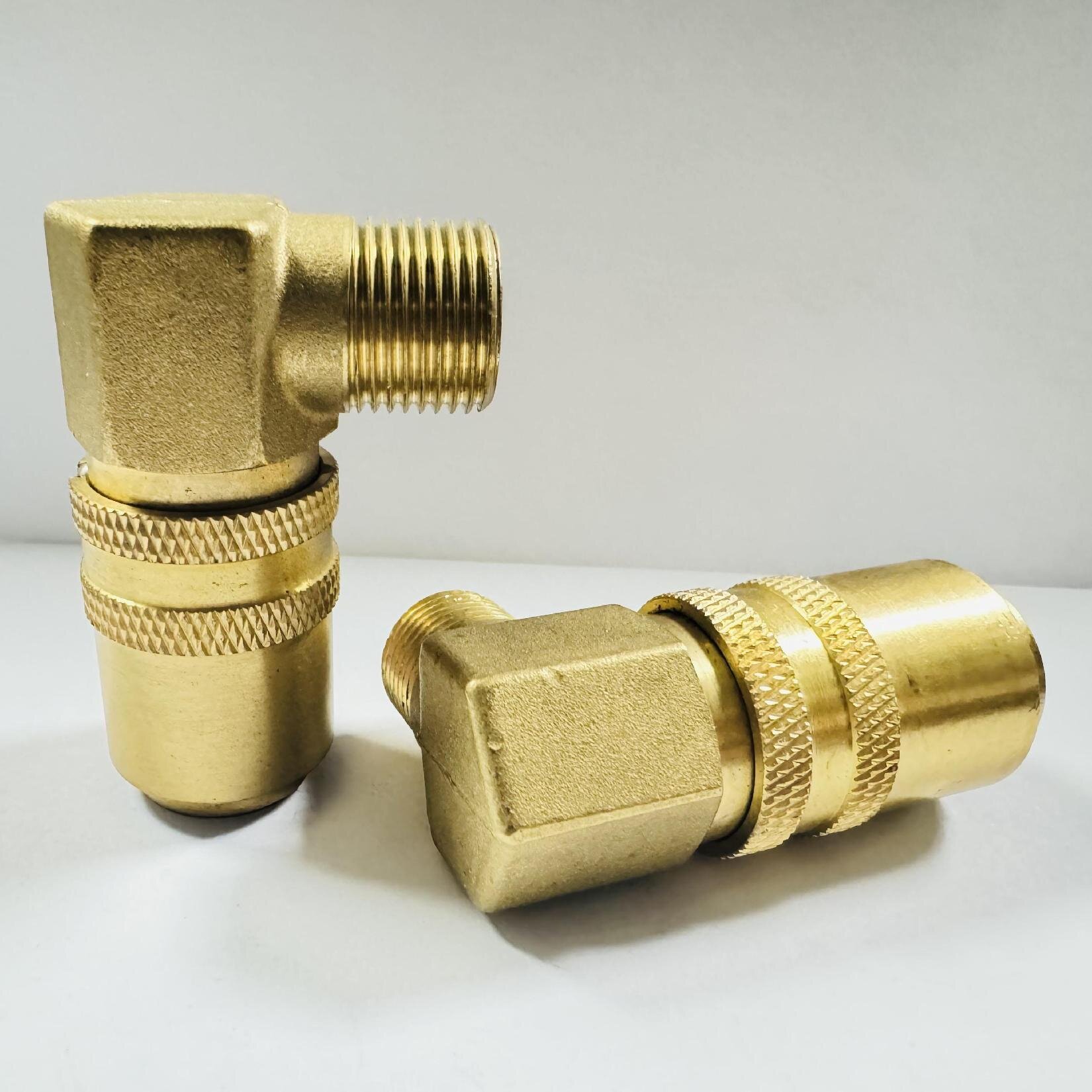
Manufacturers often view fittings as simple commodity hardware. This mindset leads to significant hidden losses. You must frame the cooling water connector as a critical node in your overall equipment effectiveness (OEE). Every thermal exchange process depends on consistent, unrestricted fluid delivery. When a connector fails or restricts flow, it directly throttles the entire machine's output. Upgrading your connection infrastructure represents a high-impact reliability improvement.
Injection molding cycle times rely heavily on cooling efficiency. The cooling phase often accounts for over half of the total cycle time. Pressure drops caused by restrictive or mismatched couplings reduce this efficiency. Slower fluid velocity means less heat transfer from the mold. This directly extends part cooling times. A minor internal restriction in a fitting can force you to add several seconds to every single cycle. Over a long production run, these seconds turn into days of lost machine capacity.
Modern manufacturing demands rapid tool changes. Single-Minute Exchange of Die (SMED) principles fail when technicians struggle with inconsistent plumbing. Quantify the time lost during mold swaps. Operators often hunt for specific adapters to mate mismatched threads. They deal with leaking, incompatible fittings that require immediate troubleshooting. Standardizing your connections eliminates this wasteful searching. It turns a chaotic, hour-long plumbing job into a swift, predictable process.
Degraded O-rings and poorly machined locking mechanisms cause unexpected leaks. These leaks create massive maintenance and scrap risks. A sudden coolant burst can contaminate a nearly finished batch of parts. It creates immediate slip hazards for floor personnel. Water or oil ingress can also damage expensive machine electronics and mold sensors. Investing in high-quality hardware prevents these catastrophic failures and keeps your production floor safe.
The fluid power industry relies on a few dominant market standards. Understanding these solution categories helps you navigate procurement. Address the reality of your current setup. Facilities rarely start from scratch. You must often match legacy tooling while planning for future upgrades. Standardizing on a single profile prevents the dangers of cross-connecting incompatible hardware.
The North American injection molding sector heavily utilizes the DME quick coupling profile. You can easily identify this profile by its specific plug geometry. It features a distinct stepped nipple design optimized for basic water applications. This design is rugged and simple to operate.
The primary advantage is widespread availability. You can source these plugs and sockets from almost any industrial supplier. However, the open market presents a major drawback. Quality varies wildly among aftermarket clones. Low-quality knockoffs often feature poor brass alloys and imprecise locking balls. This leads to premature wear and frequent coolant leaks under pressure.
European manufacturers typically standardise on the HASCO quick coupling profile. This standard features a distinct locking mechanism and highly reliable internal valving. The sleeve operation feels distinct and secure, preventing accidental disconnections during machine vibration.
These couplings serve as the ideal use case for standardized European tooling. They excel in high-precision molding environments. The tolerances on these fittings remain exceptionally tight. This tightness guarantees a secure seal even when routing hot water or pressurized glycol. If your facility imports molds from Germany or Switzerland, you will almost certainly encounter this standard.
Regional proprietary designs sometimes fail to meet global corporate standards. This is where ISO standards play a vital role. They ensure true cross-brand interchangeability. An ISO 7241 Series B plug from one manufacturer will safely mate with an ISO 7241 Series B socket from another. This eliminates the "clone trap" associated with proprietary profiles.
You should transition to flat-face, non-spill ISO 16028 couplings under specific conditions. They prove essential for high-temperature oil systems. They also dominate sensitive cleanroom environments where a single drop of spilled fluid ruins compliance. Flat-face designs prevent air inclusion during connection and eliminate fluid loss during disconnection.
Standard Profile | Primary Region | Typical Application | Key Characteristic |
|---|---|---|---|
DME | North America | General water cooling | Widespread availability, stepped plug |
HASCO | Europe / Asia | Precision cooling, high temp | Tight tolerances, secure locking mechanism |
ISO 16028 | Global | Hot oil, cleanrooms | Flat-face, zero-spill, cross-brand compatibility |
Once you identify your required profile, you must transition to performance specifications. The right quick release coupling relies on several key evaluation dimensions. These dimensions dictate how well the component survives your specific operational environment.
Your first major decision involves internal flow control. You must choose between valved and straight-through designs.
Straight-through: These models offer maximum flow and the lowest possible pressure drop. They contain no internal springs or poppets to obstruct fluid. However, they spill coolant freely upon disconnection. You must purge lines before uncoupling to avoid massive puddles.
Single/Double Shut-off (Valved): These prevent leaks during tool changeovers. A single shut-off closes the supply side, while a double shut-off seals both the supply and the mold side. They keep your floor clean. However, the internal valve creates turbulence. This requires careful flow-rate calculation to prevent cooling bottlenecks.
The body material dictates chemical resistance and structural durability. You must match the metal to your cooling media.
Brass: This remains the standard for basic water cooling. It offers a cost-effective solution with decent machinability. However, brass is highly susceptible to corrosion. Poor water quality, high mineral content, or low pH levels will quickly degrade brass components.
Stainless Steel: This material proves essential for corrosive environments. It resists aggressive rust inhibitors and harsh cleaning chemicals. Stainless steel guarantees longevity and structural integrity. It is mandatory for medical cleanrooms and food-grade molding processes.
The internal O-ring serves as the primary failure point in any fluid connection. Standard Nitrile (Buna-N) seals work adequately for basic cold water. However, you should approach standard seals with heavy skepticism in demanding applications.
Highlight EPDM for hot water and steam applications. EPDM resists degradation from boiling water better than almost any other rubber. Conversely, you must use FKM (Viton) for high-temperature thermal oils. FKM maintains its elasticity and structural integrity even when exposed to synthetic oils at extreme temperatures. Mixing these up causes rapid failure. EPDM will swell and dissolve in oil, while FKM can harden and crack in steam.
As production scales, basic connections often fall short. You must address how to scale coupling solutions for high-volume or highly complex setups. Modernization requires looking beyond individual hoses and standard materials.
Evaluate the shift from individual "spaghetti" hoses to centralized multi-connection plates. A complex mold might require twenty separate cooling lines. Connecting these individually takes significant time and invites human error. Operators easily cross lines, sending hot water into a cold circuit.
Multi-coupling plates connect all twenty lines simultaneously with a single lever pull. They guarantee perfect alignment and prevent circuit mixing. You must discuss the upfront constraints. Multi-plates require uniform mold standardization. The upfront return on investment (ROI) relies entirely on the long-term SMED benefits. If you change complex tools daily, the system pays for itself rapidly.
Processing engineered resins often requires mold temperatures exceeding 150°C (300°F). Standard push-to-connect systems exhibit severe limitations under these conditions. Locking balls can bind due to thermal expansion. Standard brass softens, reducing its pressure-holding capability.
Address these extreme scenarios with specialized hardware. You need heavy-duty stainless steel bodies. You require locking sleeves designed to handle thermal cycling without seizing. Thermal oil systems also demand redundant locking mechanisms. A blown oil line at 150°C creates an immediate, catastrophic safety incident. Relying on basic hardware for engineered resins invites disaster.
Choosing the right hardware represents only half the battle. You face specific implementation realities on the production floor. Provide actionable advice for procurement and engineering teams finalizing their decision.
We must strongly warn against mixing authentic OEM couplings with low-cost aftermarket variations. A clone might look identical to the naked eye. However, fluid power relies on microscopic precision. Micro-variations in machining tolerances lead to premature O-ring shearing.
When an operator pushes an out-of-spec plug into a high-quality socket, the plug's sharp edge cuts the seal. This causes immediate or delayed leaks. Standardize on one reputable manufacturer. Do not mix brands on the same circuit just to save a few cents per fitting.
Do not issue a purchase order without understanding your current baseline. Follow this step-by-step logic for documenting existing infrastructure:
Map the Ports: Document the port sizes on every active tool in your library.
Identify Thread Types: Distinguish between NPT (tapered) and BSPP (parallel) threads. Forcing an NPT fitting into a BSPP port destroys the mold threads.
Calculate Flow Requirements: Determine the minimum gallons-per-minute (GPM) needed for optimal heat transfer on your largest mold.
Inspect Media Quality: Test your facility water for pH and particulate levels. This dictates whether you need brass or stainless steel.
Review Operating Temperatures: Log the maximum temperature your system reaches to finalize seal material selection (EPDM vs. FKM).
Never roll out a new fluid architecture across the entire facility blindly. We recommend a strict pilot phase. Test a specific mold cooling coupling brand on a single high-cycle machine. Run this test for 30 consecutive days. Monitor the seal integrity daily. Check the locking sleeve for smooth operation.
Install flow meters to monitor any restriction caused by the new internal valves. Gather feedback from the setup technicians. If the hardware survives the 30-day pilot without leaks, sticking, or pressure drops, you can safely proceed with a facility-wide rollout.
Choosing the correct fluid hardware represents a critical exercise in facility-wide standardization. It is never just an individual component purchasing decision. Every fitting impacts your machine uptime, part quality, and operator safety. Haphazard plumbing configurations directly sabotage your overall equipment effectiveness.
Your next steps require a structured approach. Map your current tooling standards to identify whether you run DME, HASCO, or a mixed legacy system. Document your specific fluid media, temperatures, and required flow rates. Finally, consult with a technical fluid power specialist. Run exact pressure-drop calculations on your proposed hardware before committing to a new coupling architecture.
A: No. These two profiles feature entirely different physical dimensions and locking geometries. Attempting to force them together causes immediate mechanical failure, severe fluid leaks, and dangerous workplace safety risks.
A: Internal valve designs naturally create fluid turbulence. Furthermore, using fittings with an undersized internal diameter acts as a choke point. Over time, mineral buildup from poor water quality also clogs the internal pathways.
A: Replacement depends on your cycle counts and media type. You should establish a preventative maintenance framework. Replace them when visual inspections reveal pitted locking balls, stiff sliding sleeves, or brittle internal seals.
A: They are not strictly necessary, but they provide massive benefits. They prevent messy spills during tool changes. However, you must evaluate the trade-off. Their internal valves reduce overall thermal efficiency compared to straight-through designs.


