
close
Choose Your Site
Global
Social Media


Views: 0 Author: Site Editor Publish Time: 2026-09-23 Origin: Site


Inefficient compressed air connections lead to continuous pressure drops across your facility. These small gaps eventually become massive system leaks, forcing air compressors to overwork constantly. Facilities suffer costly operational downtime as a result. Selecting the correct termination style remains a core technical challenge for plant managers and engineers. You must carefully balance rapid installation speed against secure mechanical retention. The dynamic pressure of modern air systems demands exact component selection. Traditional barb designs compete daily against modern push-lock alternatives. Choosing incorrectly exposes your infrastructure to sudden blowouts and unreliable performance. This guide provides an evidence-based evaluation framework. We lay out the precise steps for specifying the right hardware. You will learn to navigate thread standards and interchange profiles. We also break down essential performance metrics to optimize your industrial air systems perfectly.
Application Dictates Design: Traditional hose barbs excel in high-vibration, heavy-duty applications but require secondary clamping; push-lock options drastically reduce assembly time but demand strict hose material compatibility.
Flow Rate Consistency: Both connection types must be sized correctly to the hose Inner Diameter (ID) to prevent bottlenecking the compressed air coupling flow.
Interchangeability Matters: The termination style (barb vs. push lock) is secondary to ensuring the coupling plug matches the socket profile (e.g., Industrial, ARO, Tru-Flate).
Thread Standards: Regional and equipment standards dictate thread types; mismatching NPT and BSP components introduces immediate leak risks.
A clear understanding of the connection anatomy prevents poor specification. A socket and a plug make up the quick-disconnect mechanism. The hose termination end connects the fitting to the actual airline. This termination might use a barb, a push-lock stem, or standard threads. A well-designed pneumatic quick coupling separates these functions clearly. Users swap tools instantly at the socket. The termination end remains permanently affixed to the hose itself.
Performance metrics dictate your selection process directly. Working pressure represents the maximum continuous force the component handles. Most shop air runs between 90 and 120 PSI. Your fittings must exceed this baseline to absorb sudden pressure spikes. Flow capacity represents the air volume passing through the system. We measure this metric in Standard Cubic Feet per Minute (SCFM). Air tools require specific flow rates to operate efficiently. A half-inch impact wrench consumes significantly more air than a small blow gun. Sizing your fittings incorrectly creates artificial bottlenecks. These bottlenecks reduce torque output and slow down production lines.
Material selection impacts longevity and safety directly. Consider these standard options when evaluating new equipment:
Brass: Offers excellent corrosion resistance and serves general-purpose applications perfectly.
Steel: Withstands high cycle rates and resists physical impacts heavily.
Composites: Provide a lightweight, non-marring alternative for sensitive environments.
A pneumatic hose barb coupling features a cylindrical stem. Angled ridges cover this stem. These ridges slide into a flexible hose and grip the internal diameter tightly. The design resists outward pulling forces effectively under constant tension.
Implementation realities demand strict attention to assembly details. This specific design mandates a mechanical fastener. You must use a worm gear clamp, an O-clip, or a crimped ferrule. The fitting will eventually blow out without one. Fortunately, barb fittings boast extensive material compatibility. They fit standard rubber, PVC, and polyurethane air hoses easily. This universal compatibility makes them a staple in repair shops.
Let us evaluate the specific operational tradeoffs for this style.
Advantage | Limitation |
|---|---|
Highly reliable under heavy side-load stress. | Slower manual installation time. |
Severe vibration rarely loosens properly crimped ferrules. | Worm gear clamps create external snag hazards. |
Extremely low risk of sudden line blow-out. | Exposed clamps can scratch or damage adjacent surfaces. |
Properly clamped connections excel in heavy fabrication areas. Workers drag hoses across abrasive concrete floors safely. The rugged exterior absorbs daily abuse without compromising the internal air seal.
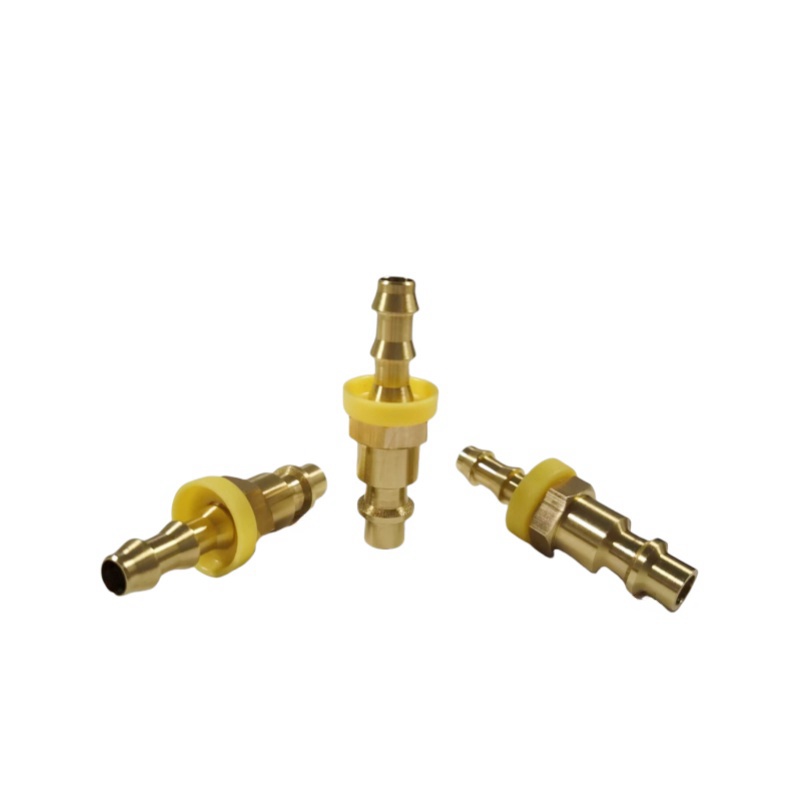
A push lock hose barb nipple features a highly specialized ridge profile. Installers push this stem directly into a compatible hose. The assembly requires no external clamps whatsoever. Pressurizing the system naturally constricts the hose tension around the barb. The grip strengthens automatically as internal pressure rises.
Implementation realities require strict operational discipline. You must pair these fittings exclusively with specified push-on hoses. Standard PVC or rubber hoses lack the required internal braiding. Forcing standard hoses onto push-lock fittings guarantees a dangerous blowout. Installation requires significant physical force. Technicians often utilize approved assembly lubricants to seat the fitting properly. However, you need zero secondary tooling or crimping machines to complete the job.
The primary advantages focus strictly on efficiency. Rapid assembly saves countless maintenance hours during large overhauls. The resulting connection features a beautifully clean, smooth profile. You completely eliminate snagging clamp heads. This clean exterior proves excellent for tight cable routing inside automated machinery.
Incompatibility remains the biggest operational hurdle. You cannot use existing standard hoses from the supply room. Disassembly also proves exceptionally difficult. Removing the fitting usually requires carefully cutting the hose away without scoring the internal brass.
Deciding between these options requires a structured, logical approach. You must calculate the labor cost of manual clamping. Compare this against the premium material cost of specialized push-lock hoses. Facilities performing high-volume hose repairs often save money using push-lock systems. The labor savings easily offset the slightly higher hose prices.
Environmental factors influence this decision heavily. High-temperature areas degrade specialized hose compounds rapidly. Heavy-abrasion environments easily destroy unarmored lines. Clamped rubber hoses on standard barbs survive these harsh zones better. Conversely, cleanroom environments require completely smooth surfaces. Automotive finishing applications cannot tolerate exposed metal clamps. A snagged worm gear clamp easily destroys a fresh paint job. Push-lock connections dominate these sensitive areas.
Standardizing your air hose quick coupling strategy prevents costly maintenance bottlenecks. Mixing connection methods across one facility causes inventory headaches and delays repairs. Follow these clear guidelines to standardize your facility infrastructure:
Audit your current environment to identify abrasive hazards or temperature extremes.
Calculate your typical monthly hose repair volume accurately.
Select push-lock systems for high-repair, low-abrasion production zones.
Select traditional clamped barbs for extreme durability requirements.
Mandate one specific standard for all new equipment purchases moving forward.
The termination end represents only half the connection equation. Your chosen compressed air coupling profile must fit existing infrastructure perfectly. Connecting incompatible plugs and sockets wastes time and causes massive leaks.
Common US profiles include Industrial (Milton), Automotive (Tru-Flate), and ARO. Each standard uses a distinct plug shape. Industrial plugs feature a wide, flat tip. Automotive plugs utilize a narrower, rounded profile. ARO plugs look similar to Industrial but feature a longer nose. Global operations typically encounter ISO 6150 B/C or Euro standard profiles. European equipment standardizes heavily on these ISO profiles to prioritize high flow rates. The Euro standard profile features a distinct valving system inside the socket. Pushing an American Industrial plug into an ISO socket might physically fit, but it will leak profusely. Always match the exact geometry.
Navigating thread standards requires equal vigilance. Plugs and sockets often thread directly into metal manifolds. You must distinguish between NPT (National Pipe Thread) and BSP (British Standard Pipe). NPT threads taper continuously to form a tight seal. BSP threads can be either tapered (BSPT) or parallel (BSPP).
Sourcing the right BSP pneumatic plug prevents disastrous installation errors. Imported machinery invariably requires BSP thread terminations. Technicians often mistake them for standard NPT connections. Forced cross-threading destroys the equipment manifold instantly. A damaged manifold requires expensive, time-consuming replacement. Always verify thread pitches using a dedicated thread gauge before applying a wrench.
Establishing proper post-installation testing protocols prevents catastrophic blowouts. Technicians must pressurize new connections gradually rather than instantly. Listen closely for hissing sounds. Apply a liquid leak detector solution across the joint. Even microscopic bubbles indicate a failing seal that requires immediate attention.
Safety compliance goes beyond simple leak checks. Large diameter hoses carry immense kinetic energy. A sudden disconnect turns a loose hose into a dangerous physical whip. You must implement physical whip checks on lines exceeding half an inch in diameter. Consider upgrading your infrastructure entirely. Safety disconnects exhaust line pressure completely before releasing the plug. This zero-pressure mechanism eliminates hose whip entirely, protecting operators from severe injury.
Routine maintenance prevents gradual system degradation. Barb ridges erode over years of constant use. Metal clamps suffer from metal fatigue. Vibration from nearby machinery travels directly through the hose. This constant movement weakens the worm gear threading over thousands of hours. Operators must physically test clamp tightness during monthly inspections. Push-lock hoses face different threats entirely. Compressor oil carryover degrades internal rubber compounds over time. Ozone exposure hardens the jacket. Hardened hoses lose their elastic grip on the internal barb. Schedule visual inspection intervals quarterly. Replace any hose showing surface cracking immediately.
Traditional pneumatic barbs offer universal utility and extreme ruggedness. They require more installation labor but survive the harshest manufacturing environments safely. Push-lock nipples provide a streamlined, rapid assembly process. They eliminate snag hazards entirely but demand strict hose pairings. Your specific facility conditions dictate the better choice.
Take immediate action to improve your air lines. First, audit your current hose inventory. Second, determine your required SCFM to avoid flow bottlenecks. Third, identify your existing interchange profile to ensure total compatibility. Finally, standardize your termination method across all departments. Consistent standards streamline future maintenance and boost overall reliability.
A: No. Standard PVC hoses lack the specific internal braiding required for proper constriction. Pressurizing a standard hose on a push-lock barb creates a severe blowout risk. You must use specifically rated push-on hoses to ensure a safe, lasting connection.
A: Examine the plug geometry. Industrial (Milton) plugs feature a shorter, wider tip with a distinct flat band. Automotive (Tru-Flate) plugs have a noticeably narrower, longer, and more rounded tip. Use a manufacturer profile chart for exact visual identification.
A: Yes, provided the fitting remains undamaged. Carefully slice the old hose lengthwise without scoring the brass or steel ridges underneath. Deep scratches on the barb will cause leaks. Always inspect the barb integrity thoroughly before inserting it into a new hose.
A: A push-lock barb inserts directly into flexible hoses, relying on natural hose tension for retention. A push-to-connect fitting receives rigid tubing (like nylon or polyurethane) directly into its body. Push-to-connect fittings use internal O-rings and metal collets to grip the tube externally.


