
close
Choose Your Site
Global
Social Media


Views: 66 Author: Site Editor Publish Time: 2026-06-04 Origin: Site


A Hydraulic Quick Coupling is a critical connection point in a hydraulic circuit because it controls sealing, flow continuity, pressure stability, and connection safety during operation. Flat face and poppet designs are two common Hydraulic Quick Coupling types, but they differ in fluid spillage, contamination resistance, pressure behavior, maintenance needs, and replacement compatibility. Choosing the right Hydraulic Quick Coupling should be based on working pressure, flow demand, fluid cleanliness, operating environment, connection frequency, thread type, body material, seal material, and coupling standard rather than only external appearance or nominal size.
● A flat face Hydraulic Quick Coupling reduces oil spillage.
● A poppet Hydraulic Quick Coupling suits many general hydraulic circuits.
● Flat face couplers offer stronger contamination control.
● Poppet couplers are often practical for high-pressure use.
● Coupling choice depends on pressure, flow, leakage tolerance, and environment.
● Thread type and interchange standard must be confirmed before replacement.
● A Hydraulic Quick Coupling should be selected by system conditions, not appearance.
A flat face Hydraulic Quick Coupling uses a flush mating surface that closes the connection area when the plug and socket are disconnected. This structure reduces exposed cavities where dust, mud, or metal particles can remain before reconnection. The flat surface also allows the operator to wipe the coupling face clean before making a connection.
A flat face Hydraulic Quick Coupling is designed to limit oil spillage during connection and disconnection. Lower oil loss is important in systems where environmental cleanliness, workplace safety, and hydraulic fluid cost are practical concerns. This type of Hydraulic Quick Coupling is commonly selected when repeated disconnection occurs in mobile equipment or tool-changing systems.
A flat face Hydraulic Quick Coupling provides strong contamination control because its face design leaves fewer recessed areas for dirt to collect. In construction, agriculture, mining, and outdoor hydraulic systems, contamination can damage valves, pumps, cylinders, and seals. By reducing dirt entry, the flat face Hydraulic Quick Coupling supports cleaner hydraulic operation and more stable component life.
Flat face Hydraulic Quick Coupling products are often used in construction machinery, compact loaders, hydraulic attachments, agricultural equipment, and mobile hydraulic circuits. These applications frequently operate in dusty, muddy, or outdoor environments where exposed couplings are easily contaminated. Flat face couplers are also suitable where low leakage and fast cleaning before reconnection are required.

A poppet Hydraulic Quick Coupling uses an internal poppet valve or similar valve element to open the flow path when the plug and socket are connected. When disconnected, spring force pushes the poppet against the seat to block fluid leakage. This structure is widely used because it is mechanically simple, proven in many hydraulic systems, and suitable for broad industrial use.
A poppet Hydraulic Quick Coupling can perform well in high-pressure hydraulic circuits when the selected series, size, material, and seal structure match the system requirements. Many poppet designs provide strong mechanical engagement and reliable valve closure under demanding operating pressure. However, the actual pressure rating of any Hydraulic Quick Coupling must be confirmed from technical data rather than assumed from its design type.
A poppet Hydraulic Quick Coupling is practical for standard hydraulic lines, agricultural machinery, hydraulic tools, test equipment, and industrial power units. It is often selected where small fluid loss during disconnection is acceptable and system cleanliness requirements are moderate. This type of Hydraulic Quick Coupling remains common in replacement projects because many existing machines already use poppet-style coupling standards.
A poppet Hydraulic Quick Coupling may release more fluid than a flat face design during disconnection. Its valve area can also be more difficult to wipe completely clean because the contact surface is not fully flush. In dirty environments, this type of Hydraulic Quick Coupling may require more careful cleaning before connection to reduce contamination risk.
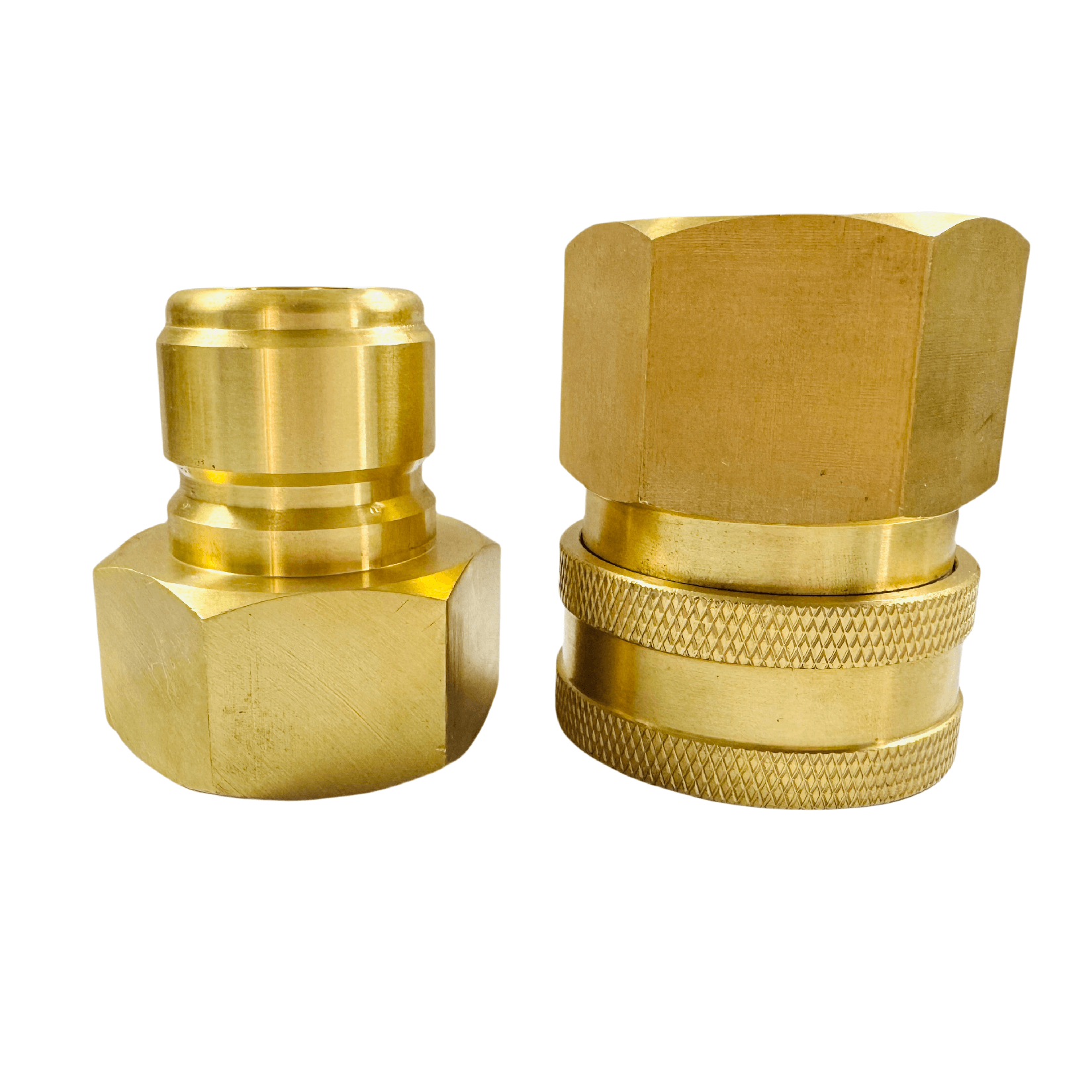
A flat face Hydraulic Quick Coupling usually provides better fluid loss control than a poppet coupling during disconnection. Poppet couplings can still seal effectively, but their internal valve geometry may allow more residual oil to escape. For hydraulic equipment operating near finished surfaces, soil, food-related areas, or environmentally sensitive locations, fluid spillage control becomes a major selection point.
A flat face Hydraulic Quick Coupling is easier to clean because the mating face is smooth and accessible. A poppet Hydraulic Quick Coupling may collect dirt around the valve opening, especially when the dust cap is not used correctly. In dusty or muddy field conditions, the flat face structure gives a practical cleaning advantage before reconnection.
A poppet Hydraulic Quick Coupling often has a lower initial cost than a comparable flat face design. A flat face Hydraulic Quick Coupling may reduce maintenance effort in systems where leakage, dirt entry, and repeated cleaning are major operating concerns. The better long-term choice depends on whether the hydraulic system prioritizes purchase cost, cleanliness, uptime, or reduced fluid waste.
Comparison Factor | Flat Face Hydraulic Quick Coupling | Poppet Hydraulic Quick Coupling |
Fluid spillage | Very low | Low to moderate |
Contamination control | Strong | Moderate |
Cleaning before connection | Easier due to flush face | More careful cleaning required |
Common standards | Often ISO 16028 | Often ISO 7241 or ISO 5675 |
Cost level | Usually higher | Usually lower |
Maintenance focus | Face cleaning and seal inspection | Valve area cleaning and seal inspection |
Best operating environment | Dirty, outdoor, low-leakage systems | General hydraulic and many high-pressure systems |
Typical use | Construction attachments, mobile hydraulics | Agriculture, industrial lines, hydraulic tools |
A flat face Hydraulic Quick Coupling is the better choice when contamination control is a high priority. It is especially suitable for systems exposed to dust, mud, sand, or frequent attachment changes. The reduced spillage design also makes this Hydraulic Quick Coupling suitable for equipment where fluid loss must be minimized during daily operation.
A poppet Hydraulic Quick Coupling is a practical choice for many standard hydraulic systems where reliability, availability, and cost control are important. It can be suitable for high-pressure applications if the pressure rating, locking structure, and seal material match the operating conditions. This Hydraulic Quick Coupling type is also useful when the existing machine already uses poppet-style plugs and sockets.
The selected Hydraulic Quick Coupling must have a working pressure rating equal to or higher than the real hydraulic system pressure. Peak pressure, pressure impulse, and vibration should be considered because hydraulic circuits rarely operate at a perfectly stable pressure. Flow rate must also match the coupling bore because an undersized Hydraulic Quick Coupling can create pressure drop, heat generation, and slower actuator movement.
A Hydraulic Quick Coupling can use BSP, NPT, metric, JIC, ORFS, SAE, or other connection ends depending on equipment origin and system design. Thread size, thread form, sealing method, and male or female end must be checked before ordering replacement parts. The interchange standard must also match because a similar-looking Hydraulic Quick Coupling may fail to connect correctly if the locking profile or valve travel is different.
Selection Factor | Choose Flat Face Hydraulic Quick Coupling When | Choose Poppet Hydraulic Quick Coupling When |
Leakage tolerance | Very low oil loss is required | Small fluid loss is acceptable |
Environment | Dust, mud, outdoor exposure, mobile machinery | Cleaner or moderate-duty environments |
Connection frequency | Frequent connection and disconnection | Occasional or standard connection cycles |
Cleaning requirement | Fast face wiping is important | Regular cleaning access is available |
Cost priority | Long-term cleanliness is more important | Initial cost control is more important |
Standard matching | ISO 16028 style is required | ISO 7241 or ISO 5675 style is required |
Replacement work | Existing flat face system must be matched | Existing poppet system must be matched |
A Hydraulic Quick Coupling should not be selected only by measuring the outside diameter or looking at the general shape. Two couplings may appear similar but have different locking grooves, valve strokes, seal locations, and interchange profiles. Incorrect matching can cause leakage, incomplete locking, restricted flow, or sudden disconnection under pressure.
A Hydraulic Quick Coupling with the wrong thread can damage the equipment port before a secure seal is achieved. Taper threads, parallel threads, O-ring face seals, cone seats, and bonded washer designs all seal in different ways. The thread form and seal method must be treated as one complete specification during Hydraulic Quick Coupling selection.
Replacing only the plug or only the socket of a Hydraulic Quick Coupling can create interchange problems if the new half does not match the existing half. Even when the nominal size is the same, the locking mechanism and valve geometry may differ between standards or manufacturers. A safe replacement should confirm coupling series, size, pressure rating, seal material, and connection profile together.
A Hydraulic Quick Coupling seal must be compatible with hydraulic oil, temperature range, additives, and any special fluid used in the circuit. NBR is common for mineral hydraulic oil, while FKM may be selected for higher temperature or stronger chemical resistance. EPDM, PTFE, and other seal materials may be needed for special fluids, but compatibility must be verified before use.
A carbon steel Hydraulic Quick Coupling is widely used in industrial machinery and mobile hydraulic equipment because it offers strong mechanical performance at practical cost. Surface treatment such as zinc plating or nickel plating can improve corrosion resistance in normal working environments. For heavy-duty use, the material strength, plating quality, locking components, and pressure rating should be checked as a complete assembly.
A stainless steel Hydraulic Quick Coupling is preferred when corrosion resistance is more important than initial cost. Marine equipment, chemical exposure, washdown areas, humid environments, and outdoor systems with aggressive corrosion risks often require stainless steel construction. The seal material must still be selected carefully because stainless steel body material alone does not guarantee full fluid compatibility.
A brass Hydraulic Quick Coupling may be used in selected lower-pressure fluid systems, but it is not automatically suitable for high-pressure hydraulic oil circuits. Brass can provide corrosion resistance in certain media, but its mechanical strength differs from carbon steel and stainless steel. Special material selection should consider pressure, fluid chemistry, operating temperature, connection frequency, and safety requirements.
A Hydraulic Quick Coupling should be checked against working pressure, peak pressure, flow rate, and operating temperature before installation. Pressure rating protects against mechanical failure, while flow capacity controls pressure drop and system heat. Temperature affects seal elasticity, fluid viscosity, and long-term sealing stability.
A Hydraulic Quick Coupling used in outdoor equipment needs stronger contamination control and corrosion protection than one used inside a clean hydraulic power unit. Flat face designs are often preferred where dirt exposure and frequent cleaning are expected. Poppet designs remain practical where the operating environment is less contaminated and routine maintenance is controlled.
A replacement Hydraulic Quick Coupling should match the original coupling standard, thread end, body material, seal type, and pressure rating. Custom hydraulic connections may require drawings, samples, pressure data, flow requirements, and port specifications for accurate matching. Confirming these details before production reduces leakage risk, installation problems, and system downtime.
Flat face and poppet Hydraulic Quick Coupling designs both have clear advantages, but they serve different operating priorities. A flat face Hydraulic Quick Coupling is generally preferred for low spillage, cleaner connection, and contamination-sensitive hydraulic systems, while a poppet Hydraulic Quick Coupling remains practical for standard hydraulic circuits, many high-pressure applications, and cost-sensitive replacement work. Before selecting a Hydraulic Quick Coupling, pressure rating, flow rate, thread type, seal compatibility, material, environment, and interchange standard should be checked together. For hydraulic systems involving industrial machinery, agricultural equipment, construction machinery, or custom fluid connection requirements, Dongguan Tianying mold fitting Co., Ltd. can provide Hydraulic Quick Coupling options based on drawings, samples, pressure data, thread specifications, flow requirements, and operating conditions.
A flat face Hydraulic Quick Coupling has a flush connection surface that reduces spillage and improves contamination control. A poppet Hydraulic Quick Coupling uses an internal valve element to seal the flow path when disconnected. The main difference is the balance between cleanliness, leakage control, cost, and general hydraulic suitability.
A flat face Hydraulic Quick Coupling is not always better because the correct choice depends on the hydraulic system. It is better for low leakage, frequent connection, and dirty operating conditions. A poppet Hydraulic Quick Coupling may be more suitable for standard systems, existing replacements, and applications where its pressure rating and interchange standard match.
A poppet Hydraulic Quick Coupling should be selected when the application uses a compatible poppet standard and does not require the lowest possible spillage. It is common in agriculture, industrial hydraulic lines, hydraulic tools, and many general-purpose circuits. The selected Hydraulic Quick Coupling must still match pressure, flow, thread, and seal requirements.


