
close
Choose Your Site
Global
Social Media


Views: 0 Author: Site Editor Publish Time: 2026-09-30 Origin: Site


In injection molding, cycle times dictate profitability. The efficiency of your mold cooling lines directly controls part quality and machine uptime. A minor flow restriction can cause catastrophic delays across your entire production floor. Many facilities overlook the severe consequences of improper component selection in these thermal systems. When operators select the wrong hardware, you face unplanned maintenance due to leaks, uneven cooling causing hot spots, and accelerated tool wear. These disruptions destroy production schedules and damage expensive molds.
This article provides tooling engineers and maintenance managers a complete technical evaluation framework. You will learn how to select the right components to optimize cooling circuits effectively. We detail material limits, thread compatibilities, and flow dynamics. Our guide empowers you to make reliable hardware choices, prevent leaks, and speed up mold changeovers.
A properly specified brass fitting balances thermal tolerance, cost, and corrosion resistance for standard water and glycol-based mold cooling systems.
Component selection (e.g., a brass hose barb nipple vs. a quick-disconnect) directly impacts mold changeover speeds and pressure drop profiles.
Thread compatibility (NPT vs. BSPT) and mitigating galvanic corrosion are the two most critical risk factors in deployment.
Supplier validation must prioritize verified pressure ratings and precision-machined internal bores to ensure laminar flow.
Brass remains the undisputed industry standard for tooling cooling circuits. Engineers continuously choose it over plastics, carbon steel, and stainless steel for highly specific reasons. The material offers a unique balance of thermal conductivity, machinability, and inherent corrosion resistance. When injection molds cycle rapidly, the surrounding components must endure severe thermal fluctuations. Brass pulls heat away more efficiently than carbon steel, preventing localized heat buildup near connection points.
Performance outcomes depend heavily on the specific alloy. Quality alloys demonstrate natural dezincification resistance. This property prevents the metal from degrading when exposed to prolonged moisture. Furthermore, brass provides exceptional durability under repetitive mold-change stress. Maintenance teams constantly connect and disconnect lines. Plastic connections crack under this mechanical stress, while carbon steel rusts. Brass absorbs mechanical shock without fracturing.
However, you must acknowledge material limitations. Brass fails in specific environments. It proves unsuitable for highly aggressive chemical coolants, acidic fluids, or abrasive slurries. You should never deploy it in extreme high-pressure hydraulic lines where steel is mandatory. Chemical compatibility dictates long-term success.
Let us assess coolant compatibility:
Municipal Water: Excellent compatibility. Naturally forming oxide layers protect the internal surfaces.
Ethylene/Propylene Glycol Mixtures: Highly compatible. Glycol formulations typically include inhibitors preventing metal degradation.
RO (Reverse Osmosis) Water: Proceed cautiously. Unbuffered RO water aggressively attacks brass, stripping zinc from the matrix. You must introduce appropriate buffering agents.
Material | Thermal Conductivity | Corrosion Resistance (Water) | Mechanical Durability |
|---|---|---|---|
Plastics (e.g., Nylon) | Poor | Excellent | Low (Prone to cracking) |
Carbon Steel | Moderate | Poor (High rust risk) | High |
Stainless Steel | Moderate | Excellent | Very High |
Brass | High | High (Alloy dependent) | High |
Mapping specific components to structural routing needs prevents bottlenecks inside the injection molding setup. Each configuration serves a distinct mechanical purpose. Selecting the wrong geometry forces fluid through inefficient pathways, ultimately slowing down your cooling cycle.
When routing flexible hoses to low-to-medium pressure supply lines, you need secure retention. A brass hose barb nipple serves this exact function. It provides a serrated profile gripping the internal diameter of rubber or silicone tubing. Barb count and depth matter immensely. Shallow barbs lead to catastrophic blow-offs during sudden pressure spikes. Always specify deep-cut barbs and secure them with industrial hose clamps. This configuration ensures rapid deployment and easy line replacement during tool changeovers.
You frequently encounter situations requiring two female-threaded ports to connect securely. A brass hex nipple resolves this structural challenge. It features male threads on both ends separated by a hexagonal center section. The hex center allows technicians to apply precise torque using a wrench. This design prevents operators from gripping the threaded sections directly, which distorts the internal bore and ruins the seal.
Global manufacturing floors frequently mix European molding machines with US-built tooling. You cannot force metric threads into standard imperial ports. A brass adaptor becomes essential for transitioning between mismatched equipment standards. These components change thread types or genders smoothly without restricting fluid momentum. Using the correct transition piece eliminates the risk of cross-threading expensive mold bases.
Cooling manifolds distribute high-volume water into smaller individual mold channels. Stepping down the pipe size requires a brass reducer. You must address the risk of pressure drops here. If the internal taper is not properly engineered, the fluid experiences sudden turbulence. A gradual internal reduction taper maintains fluid velocity, ensuring your individual mold cavities receive adequate thermal transfer.
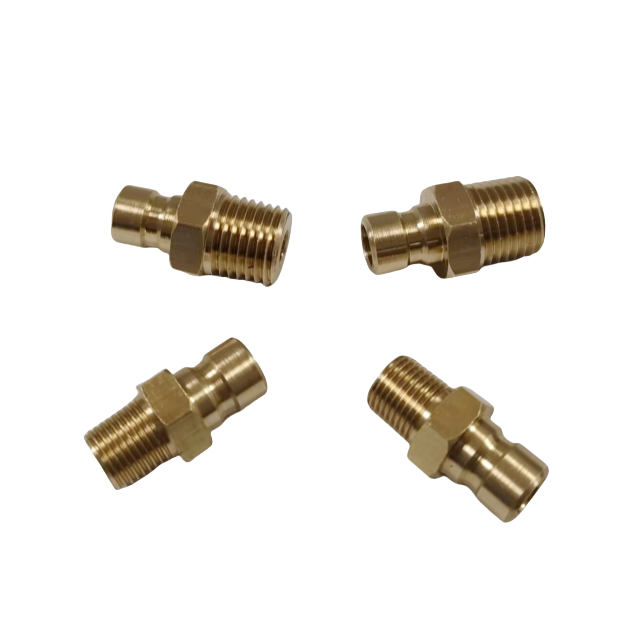
You must match physical specifications directly to desired cycle-time outcomes. A cooling system acts as a hydraulic circuit. Any flaw in the component dimensions degrades overall thermal efficiency.
Thread standards present the most common engineering trap. You will encounter three primary standards in global tooling:
NPT (National Pipe Taper): The North American standard. It seals by wedging the threads together.
BSPT (British Standard Pipe Taper): Common in Europe and Asia. The thread angle differs slightly from NPT.
Metric Threads: Standardized parallel threads requiring an O-ring or sealing washer.
Never force incompatible threads together. Forcing an NPT male into a BSPT female creates spiral leak paths. These micro-leaks spray atomized water across the production floor, posing safety hazards and damaging electrical sensors.
Internal bore machining significantly impacts cooling efficiency. A poorly cast mold cooling fitting harbors internal burrs and rough surfaces. These imperfections disrupt fluid momentum, causing turbulence. Smoother internal bores promote laminar flow. Laminar flow ensures consistent, predictable heat transfer away from the mold cavities. You must prioritize components boasting high-quality internal finishes.
Engineers constantly balance wall thickness against clearance constraints. High-cavitation mold plates pack cooling lines tightly together. You need thin-walled components to fit these tight physical clearances. Conversely, thin walls fracture easily under water hammer effects. You must calculate the maximum system pressure spikes and select a wall thickness capable of withstanding those forces without consuming unnecessary space on the tool plate.
Field failures rarely happen due to inherent material flaws. They almost always result from installation errors, poor maintenance, and chemical oversights. Understanding these realities prevents costly downtime.
Galvanic corrosion represents a silent, severe threat. Mating brass directly with an aluminum mold base creates a galvanic cell. Add an electrolyte like factory cooling water, and the aluminum begins corroding rapidly. You will eventually see severe pitting around the water channels. To mitigate this risk, you must implement practical strategies. Using dielectric unions breaks the electrical conductivity between the two metals. Alternatively, adding specialized corrosion inhibitors to the closed-loop coolant neutralizes the electrolytic properties of the water.
Sealing best practices dictate whether a system remains dry. Technicians debate between PTFE tape and anaerobic liquid sealants. Both work effectively when applied correctly.
PTFE Tape Application: Wrap the tape in the direction of the threads. Use only two to three layers. Excess tape prevents proper thread engagement and fractures female ports.
Anaerobic Sealants: These liquid compounds cure in the absence of oxygen. They fill microscopic gaps perfectly. However, they require clean, oil-free threads to bond correctly.
Common Mistakes: Over-torquing tapered threads stretches the female port. Once deformed, the port will leak regardless of the sealant used.
Maintenance realities require establishing strict visual inspection intervals. Instruct your team to look for signs of dezincification. A white powdery buildup around the connection points indicates early oxidation. A distinct pinkish discoloration means zinc is leaching out of the alloy, leaving behind porous, weakened copper. Components exhibiting a pink hue require immediate replacement before catastrophic blowout occurs.
Moving from technical evaluation to procurement demands a rigorous auditing framework. You cannot treat these components as generic commodities. Poor quality control at the manufacturing level directly threatens your operational uptime.
Start with alloy verification. When you source a brass fitting, always request Material Test Reports (MTRs). These documents prove the supplier uses standard, reliable alloys like CA360 or CA377. If your facility runs dual-use water systems connecting to potable lines, verify low-lead or no-lead compliance to meet regulatory standards.
Next, evaluate manufacturing tolerances. Precision CNC-machined components outlast standard cast alternatives significantly. Injection molding environments generate intense, continuous vibration. Cast components feature looser thread tolerances, allowing vibration to back the connections out over time. CNC-machined parts offer exacting thread pitches. They lock together tightly, resisting vibrational loosening.
Finally, assess supply chain scalability. Proprietary mold setups often require custom run requirements, such as extended thread lengths or unique hex sizes. Your supplier must possess the engineering capability to deliver custom solutions. However, you also need off-the-shelf bulk availability. When a line snaps at 2:00 AM on a Sunday, you rely on immediately accessible replacements to minimize machine downtime. Balance your supplier choice between their custom engineering strength and their localized inventory depth.
Optimizing your injection molding cooling lines requires meticulous component selection. Deploying the correct materials, matching thread standards perfectly, and ensuring smooth internal bores directly reduces your cycle times. Every incremental improvement in heat transfer extends your overall mold life and yields higher quality parts.
We recommend conducting a full technical audit of your current cooling circuits. Identify any flow restrictions, mismatched threads, or signs of galvanic corrosion. Document areas experiencing recurring leaks. Contact a specialized engineering sales team to review your specific routing challenges. Request technical drawings, flow rate data, and physical samples to test on your next tooling setup.
A: We generally advise against it for industrial molds. Plastics suffer severe temperature limitations and become brittle over time. During frequent tool changes, mechanical stress easily cracks plastic threads and barbs. Brass offers vastly superior durability, temperature tolerance, and mechanical strength required for robust manufacturing operations.
A: Leaks usually stem from three common issues. First, you may have a thread mismatch (e.g., forcing NPT into BSPT). Second, over-torquing may have cracked or deformed the mold's female port. Finally, worn or shallow barbs fail to grip the hose securely under pressure. Inspect all three areas.
A: Yes, they exhibit good chemical compatibility with many synthetic oils. However, you must carefully evaluate temperature ratings. High-temperature oil circuits often exceed the safe operational limits of standard brass alloys. For extreme high-temperature oil applications, we strongly recommend specifying stainless steel or carbon steel components instead.
A: The choice depends on your structural objective. You use a reducer specifically to change the pipe size within a line (e.g., stepping down from a 1-inch manifold to a 1/2-inch channel). You use an adaptor to change thread types (NPT to BSPT) or to change thread gender (male to female).


